Back in August of last year, I signed up for a running gait analysis because I just started running consistently and was building up my mileage, and I was curious about ways to improve my biomechanics. I happened to be in nyc at the time so I did some research and found a place called Custom Performance. I’m currently training for my second half marathon and I had been thinking about reincorporating some of the stuff that I got from my session for injury prevention and also thought, why not just share it here as well? Obviously, these recommendations are personalized for me but should give you a sense of what you’ll get from a session. It was hugely helpful for me at the time (Thanks Lauren!) and continues to be something I reference from time to time to make sure I’m not slipping back into old habits.
Basically, they asked me some basic questions about my running history, weekly mileage, and any conditioning or strength routines, and then they had me run on a treadmill for about five to ten minutes while they filmed me from both the side and the back with an iPad. The treadmill was equipped to measure things like ground contact time. As part of the package, you also get a follow-up session where you review any changes you’ve made or improvements after incorporating the recommendations.
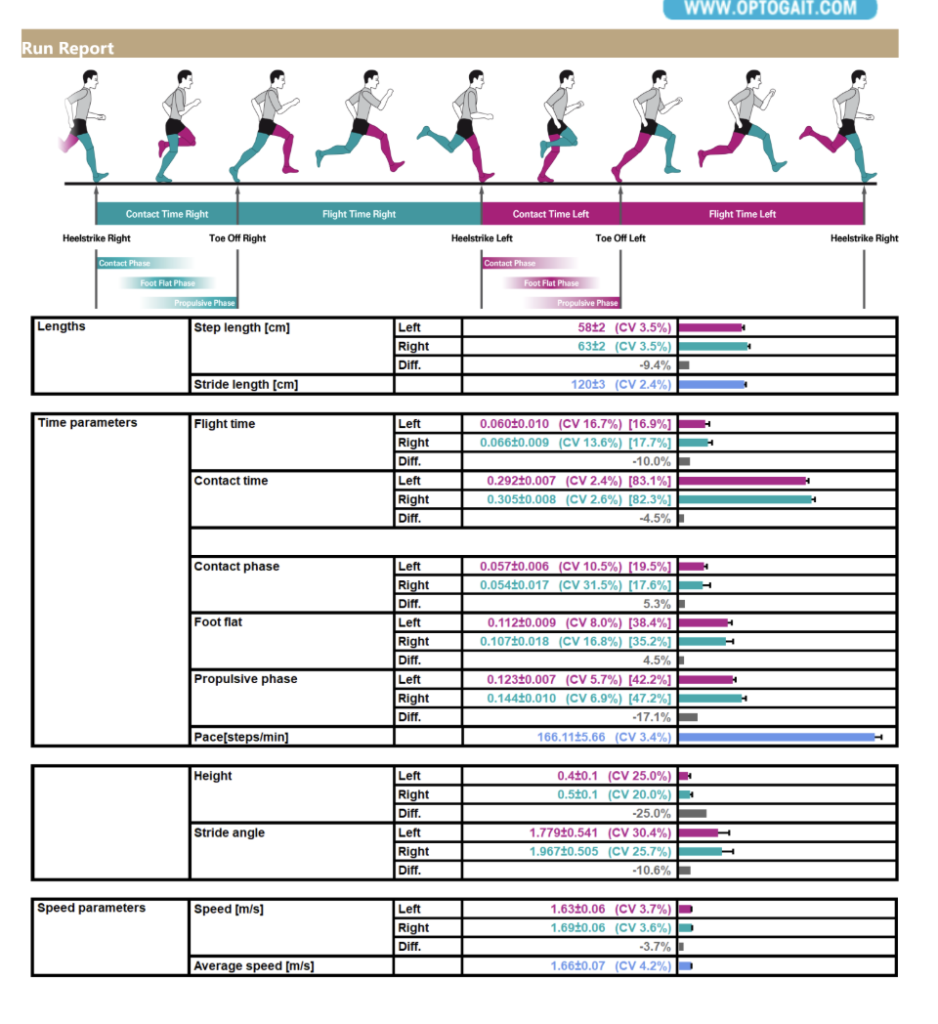
First, here’s the actual numbers from the gait analysis printout – this contains some visuals that are helpful for understanding the actual summary & recommendations that they provided that I share farther down below. In general the key things I had to pay attention to were asymmetries.

Analysis Summary
Optogait Results
- Contact Time: Symmetrical (Good).
- Flight Time: Asymmetrical, favoring the Right Leg (spending more time in the air on the right side).
- Propulsive Phase: Asymmetrical, favoring the Right Leg (spending increased time pushing off with the right leg).
- Stride Risk:Increased, which puts you at higher risk for Iliotibial Band Syndrome (ITBS).
- Higher risk on the Right Leg.
- This is linked to the observed pelvic drop/hip “meltdown”.
- Pace (Cadence): Currently 166 steps/minute.
- Goal: Increase to 174 steps/minute (a 5% increase) to help reduce injury risk.
Gait Mechanics
- SAGITTAL VIEW (Side View)
- Over-stride bilaterally.
- Excessive LEFT arm power-back compared to the right arm, which may indicate right leg weakness.
- Excessive tibial inclination angle (related to the over-stride).
- FRONTAL VIEW (Front/Back View)
- Pelvic drop bilaterally (indicates gluteus medius weakness).
- Upper extremity cross-body rotation bilaterally (inefficient momentum push).
Recommended Cues, Drills, and Exercises
Gait Cues
- Focus on having ‘headlights’ on the front of your kneecaps to cue pushing your knees out and preventing the collapsing pattern.
- Imagine running with both feet on either side of a line to avoid the knee collapsing pattern.
- Note: Apply these cues intermittently, not for the entire run.
Drills (To be performed pre-run)
- Arm Swing Drill:
- 1 x10-15 reps, in standing, using 5# dumbbells.
- Knee Drives @ Wall:
- 1×10-15 reps, using a yellow band.
- Focus on the power move of the knee driving up in line against light resistance.
- Work both sides for all drills.
Exercises (Workouts)
| Exercise | Weight/Band | Sets x Reps | Key Instructions |
| Single Leg RDLs | 15# (opposite hand) | 2-3×8 | Stand on one bent leg; hinge at the hip with a neutral spine, lowering the weight towards your foot. Squeeze the glutes/hamstrings to return. Ensure hips are squared. Work both sides. |
| Box Step-Ups | 2×15# dumbbells | 2-3×15 | Step up onto a box, perform a power stance knee drive on the opposite leg, then slowly lower. Alternate sides. |
| Knees to Knees & Toes to Toes | Green Band | 2-3×6-8 | Modified side plank with band around lower legs. Rotate from hips to touch knees, then rotate to touch heels, keeping legs separated. Should be felt in the side butt and deep hip rotators. Work both sides. |
| Tall Plank Thread the Needles | Bodyweight | 2-3×6 | In a tall plank, bring one arm under and across the body (thread), then rotate to bring it up and out to the side. Works core and integrates thoracic spine rotation. Work both sides. |
Other Takeaways
The analysis doesn’t fully explain some of the asymmetries but I’ve done some research and have been able to come up with some plausible theories.
- For the longer right leg propulsive time, that’s likely caused by overcompensation due to weakness of my left leg. Strengthening my left leg helps correct the imbalance. It’s like I’m really quickly trying to get off of my left leg because it’s weak. This is also supported by my injury history on my left leg – back in college I actually tore my achilleas tendon!
- Their prediction that my right leg had a higher risk of ITBS syndrome to spot on – actually had that the year before (my right leg!) and had to visit physical therapists to rehabilitate it. working on strengthening my glute meds basically made this problem go away
- My current cadence is about in the mid 170s and really does make a difference – I feel like I’m the landing softer each step.
If you end up doing analysis for yourself let me know how it goes! I highly recommend it.